
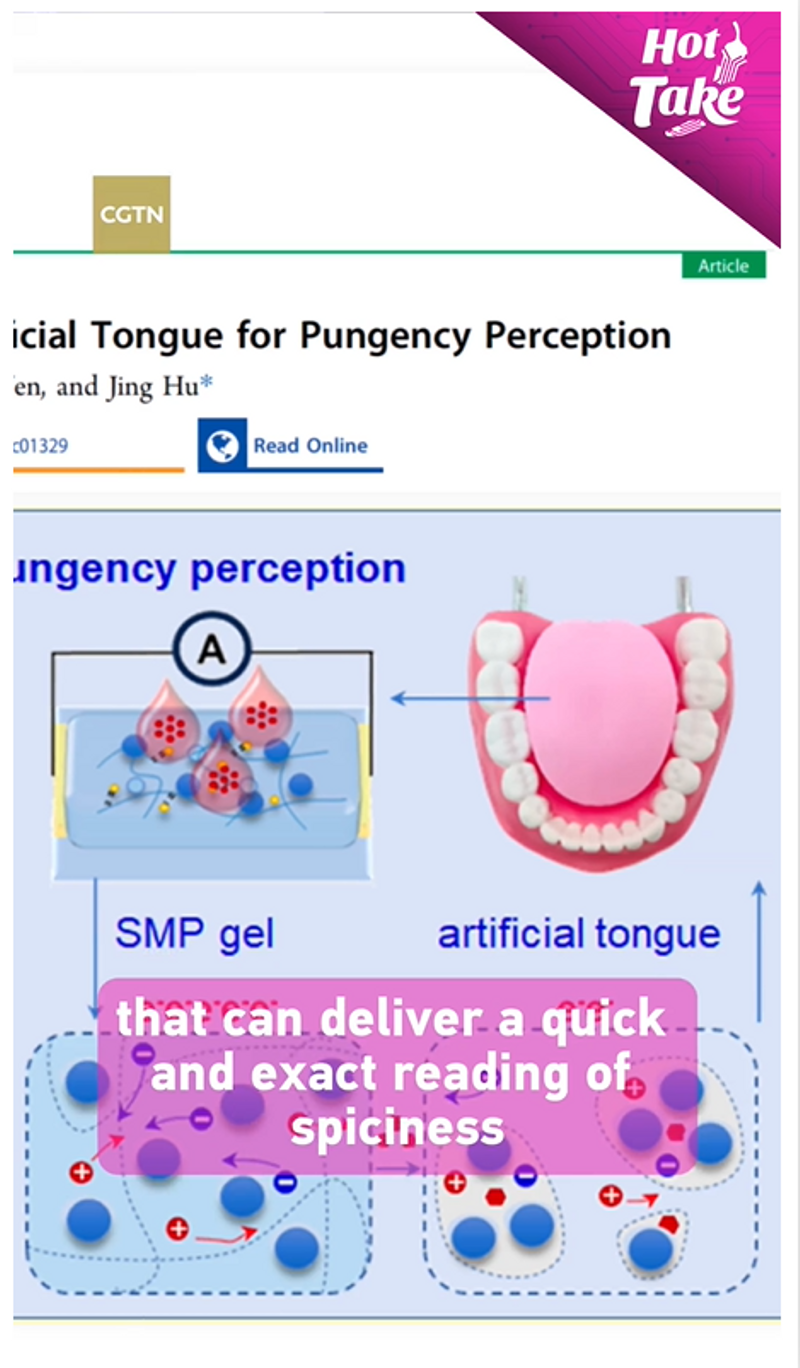
A group of Chinese scientists has developed a gel-based 'chili meter' that provides quick, precise readings of spiciness, helping you avoid tongue-searing burns and watery eyes.
'The evaluation of spiciness is highly subjective,' said Hu Jing, a professor at East China University of Science and Technology, and also the corresponding author of the latest study on this artificial tongue.
'When we were working on this, we hoped to develop a way to measure spiciness without relying on human senses, a material that can directly assess the level of spiciness,' Hu told CGTN.
The idea comes from a familiar remedy: milk soothes chili burns. That's because milk proteins bond with capsaicin – the compound that makes peppers hot.
So, the team developed a soft, stretchable gel filled with milk proteins. When it touches capsaicin, the proteins latch onto it, blocking ion flow in the gel.
It can also measure the pungency of garlic, onions, ginger and more.
In the future, such material could be used for food quality control, medical treatment, and possibly even to address a major gap in today's humanoid robots: the sense of taste.
Hu said that she hopes they can further integrate the material with humanoid robots and artificial intelligence, so that it can have wider applications in our lives.